- Read the book online (Free)
- Download the PDF (Free)
- Buy the Paperback ($4.99) (coming soon)
- Buy the Kindle edition ($0.99) (coming soon)
What has been believed everywhere, always, and by all.
This work is dedicated to the public domain (Creative Commons CC0 1.0). No rights reserved.
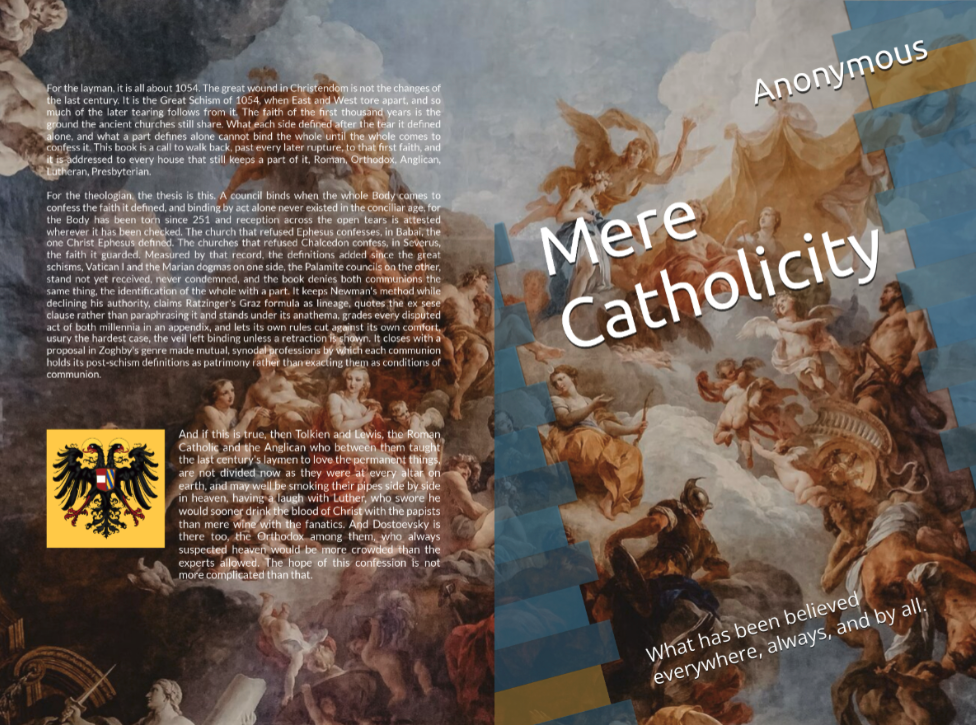
And if this is true, then Tolkien and Lewis, the Roman Catholic and the Anglican who between them taught the last century's laymen to love the permanent things, are not divided now as they were at every altar on earth, and may well be smoking their pipes side by side in heaven, having a laugh with Luther, who swore he would sooner drink the blood of Christ with the papists than mere wine with the fanatics. And Dostoevsky is there too, the Orthodox among them, who always suspected heaven would be more crowded than the experts allowed. The hope of this confession is not more complicated than that.
from the afterword
For the layman, it is all about 1054. The great wound in Christendom is not the changes of the last century. It is the Great Schism of 1054, when East and West tore apart, and so much of the later tearing follows from it. The faith of the first thousand years is the ground the ancient churches still share. What each side defined after the tear it defined alone, and what a part defines alone cannot bind the whole until the whole comes to confess it. This book is a call to walk back, past every later rupture, to that first faith, and it is addressed to every house that still keeps a part of it, Roman, Orthodox, Anglican, Lutheran, Reformed.
For the theologian, the thesis is this. A council binds when the whole Body comes to confess the faith it defined, and binding by act alone never existed in the conciliar age, for the Body has been torn since 251 and reception across the open tears is attested wherever it has been checked. The church that refused Ephesus confesses, in Babai, the one Christ Ephesus defined. The churches that refused Chalcedon confess, in Severus, the faith it guarded. Measured by that record, the definitions added since the great schisms, Vatican I and the Marian dogmas on one side, the Palamite councils on the other, stand not yet received, never condemned, and the book denies both communions the same thing, the identification of the whole with a part. It keeps Newman's method while declining his authority, claims Ratzinger's Graz formula as lineage, quotes the ex sese clause rather than paraphrasing it and stands under its anathema, grades every disputed act of both millennia in an appendix, and lets its own rules cut against its own comfort, usury the hardest case, the veil left binding unless a retraction is shown. It closes with a proposal in Zoghby's genre made mutual, synodal professions by which each communion holds its post-schism definitions as patrimony rather than exacting them as conditions of communion.
It is not a new church, for it founds nothing. It is not liberalism, for the moral consensus of the Fathers is kept entire. And it is not a movement. There is nothing to join and nothing for sale.
The laity may pass over the memorandum, which is addressed to the commissions, and read the first three sections, the position, what is held, and what is declined, then turn to the afterword, Counsel for the layman. The technical argument begins at section four and will still be there when you are ready for it.
The confession
I hold the whole faith of the undivided Catholic Church: the Holy Scriptures, the Nicene Creed, the seven Ecumenical Councils, the apostolic succession and the government of bishops, the sacramental mysteries and the real presence of Christ in the Eucharist, the regeneration given in Baptism, and the consensus of the Fathers and the sensus fidelium of the first thousand years.
I honor the Bishop of Rome as first among equals, within the limits the Fathers of East and West both knew. I hold that Christ preserves His whole Church from final failure, and that outside this Church there is no salvation, because the Church is His Body, one across her present divisions, and it is entered by faith and baptism.
Quod ubique, quod semper, quod ab omnibus.